There's a conversation nobody prepares you for when you start your business. It's not about landing clients—it's about letting them go.
We're taught that every client is precious, that losing one is failure. But here's what took me years to learn: some client relationships cost more than they're worth. Not just in money, but in energy, reputation, and the opportunities you miss while managing chaos.
Firing a client feels counterintuitive. It feels risky. Sometimes it feels impossible. But knowing when and how to end a professional relationship is one of the most important skills you can develop.
The Real Cost of a Bad Client
Before we talk about red flags, let's talk about what's actually at stake.
A difficult client doesn't just take up time on their projects. They take up mental real estate. They're the reason you check email with dread. They're why Sunday evenings feel heavy. They're the stories you vent about to friends, the situations that keep you up at night.
Meanwhile, your best clients—the ones who respect your expertise, pay on time, and make work enjoyable—get whatever energy is left over.
That's the hidden math of bad client relationships. You're not just losing the hours you bill. You're losing the quality of hours you give everyone else.
Red Flags That Signal It's Time
🚩 They Don't Respect Boundaries
It starts small. A text after hours. A "quick call" on your day off. Feedback delivered at 11 PM with an expectation of immediate response.
Boundary violations escalate. A client who texts you once on a Saturday will eventually expect weekend availability. What feels like flexibility on your part registers as availability on theirs.
The test: Have you clearly communicated your boundaries? If yes, and they continue to push, that's not a misunderstanding. That's disrespect.
🚩 Scope Creep Has Become Scope Avalanche
"While you're at it, could you also..." is a phrase that should make you pause.
Some scope expansion is natural. Projects evolve. But there's a difference between organic growth and a client who treats every deliverable as an opening bid.
The test: When you raise scope changes, do they acknowledge the additional work and discuss compensation? Or do they act confused that you'd even mention it?
🚩 Payment Is Always a Battle
Late payments happen. But there's a pattern that emerges with certain clients: the check is always "in the mail." Invoices need to be "reviewed" for weeks. Payment terms you agreed upon somehow become negotiable after the work is done.
Chasing money you've already earned is exhausting and demoralizing. It also warps the relationship—you become a creditor, not a partner.
The test: Is getting paid a routine transaction or an ongoing negotiation?
🚩 They Treat You Like an Employee, Not a Partner
You were hired for your expertise. But somewhere along the way, this client stopped asking for your input and started dictating exactly what they want, how they want it, and when—regardless of whether it's the right approach.
Being micromanaged as an independent professional is a particular kind of frustrating. You carry all the risk of self-employment with none of the autonomy.
The test: When you push back with professional recommendations, are you heard? Or overruled?
🚩 The Goalposts Never Stop Moving
You deliver what was asked. It's not quite right. You revise. Still not there. You revise again. The feedback is vague or contradictory. Somehow, approval always seems one more round away.
Some clients genuinely don't know what they want. That's manageable with the right process. But others use ambiguity as a weapon—consciously or not—to extract endless work from a fixed agreement.
The test: Can you point to clear, documented approval criteria? If everything is subjective, the project can never truly be complete.
🚩 Your Gut Keeps Telling You Something Is Wrong
Sometimes you can't articulate what's off. The emails are polite enough. The payments mostly arrive. But every interaction leaves you feeling vaguely bad.
Trust that instinct. Your subconscious is processing signals your conscious mind hasn't catalogued yet. Persistent dread about a client relationship is data.
🚩 They're Damaging Your Reputation
This is the most serious red flag. If a client is asking you to do work that's below your standards, misrepresenting your involvement to others, or creating situations where your name is attached to outcomes you can't control—that's not just a bad client. That's a threat to your business.
Use a Client Health Scorecard
A difficult week is not automatically a bad relationship. Before ending a contract, separate a temporary problem from a repeated operating pattern. Review the previous four to six weeks and score observable behavior: payment, scope control, respect for boundaries, decision ownership and reputational risk.
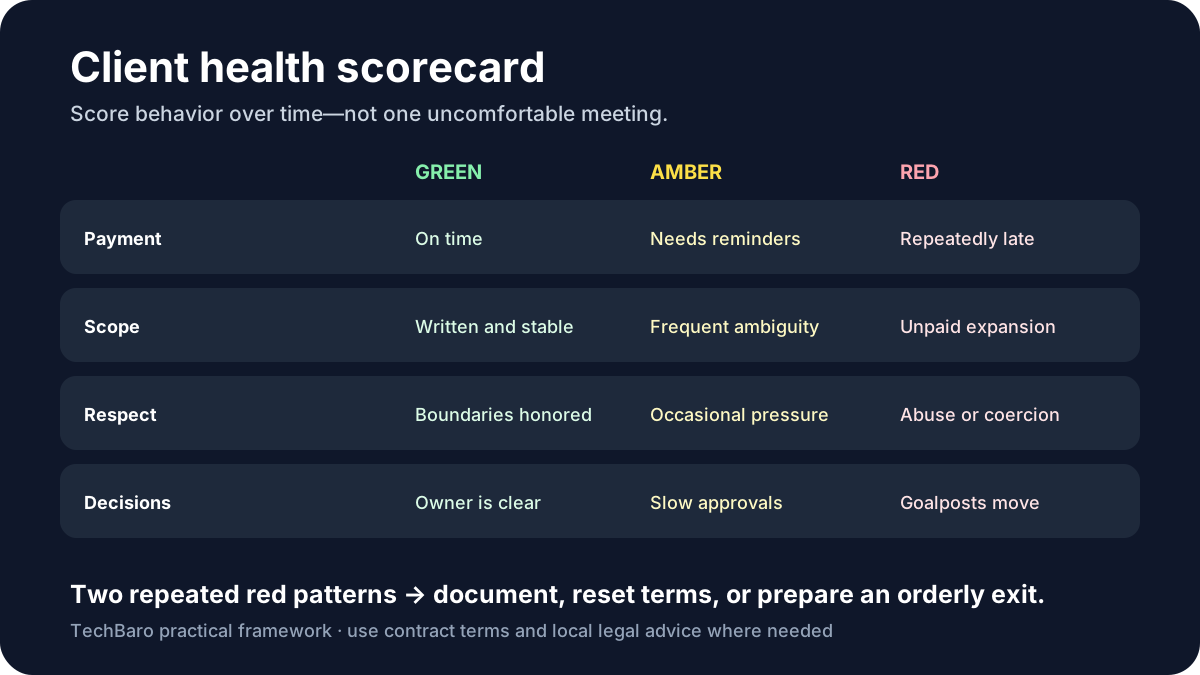
Green means the working agreement is functioning. Amber means the relationship needs a specific reset: a new approval owner, a paid change-request process, a shorter payment term or a defined communication window. Red means the behavior threatens your finances, health, legal position or professional reputation.
For every amber or red mark, write down one dated example and the business impact. “The client is disorganized” is an emotion; “three approvals arrived after the agreed deadline, moving delivery by eight working days” is evidence. Evidence makes the next conversation calmer and gives both parties a fair chance to correct the system.
A simple decision rule
One amber pattern calls for a reset. Two repeated red patterns call for an exit plan. Immediate threats, harassment, illegal requests or serious non-payment may justify faster action, subject to your contract and appropriate local advice.
The Exit: How to Fire a Client Gracefully
Once you've decided to end a relationship, the goal is to exit professionally. You want to preserve your reputation, fulfill your ethical obligations, and ideally, avoid burning bridges.
1. Complete Your Current Commitments
Unless there's an ethical issue that requires immediate termination, finish what you've agreed to deliver. Walking away mid-project—unless you have very good reason—reflects poorly on you, not them.
2. Choose the Right Moment
Don't end things in the heat of a frustrating exchange. Wait until you're calm and can communicate clearly. Look for natural transition points: the end of a project, the close of a quarter, a contract renewal date.
3. Be Direct but Diplomatic
You don't owe anyone a detailed explanation of why you're ending the relationship. In fact, the less you say, the better.
"After giving it careful thought, I've decided that I'm not the right fit for your needs going forward. I want to give you enough notice to find someone who can serve you better."
Notice what this doesn't do: it doesn't blame them, list grievances, or open a negotiation. It's a decision, not a discussion.
4. Offer a Transition
If appropriate, provide a reasonable transition period. Offer to hand over files, documentation, or recommendations for other providers. This demonstrates professionalism and makes the separation smoother.
Put It in Writing
Send a follow-up email confirming the end date, any final deliverables, and how outstanding invoices will be handled. This protects both parties and prevents ambiguity.
Don't Badmouth Them
The professional community is smaller than you think. However justified your frustrations, venting publicly—or even semi-publicly—will reflect worse on you than on them. Process your feelings with trusted friends outside your industry.
What Comes Next
Here's the part nobody tells you: firing a client feels terrible. Even when you know it's right, there's grief. There's second-guessing. There's anxiety about the income you're walking away from.
That's normal. Sit with it.
But pay attention to what happens next. Often, within weeks, something shifts. The mental space that difficult client occupied opens up. You have energy for projects you'd been neglecting. You say yes to opportunities you would have turned down.
Difficult clients take up more room than they pay for. When they're gone, you see just how much space they were consuming.
Rebuild the pipeline before the next gap becomes urgent with the weekly freelance developer client acquisition system.
The Bigger Lesson
The ability to fire a client rests on something deeper: the belief that you deserve better.
Not better in an entitled sense. Better in the sense that your work has value. That your time and expertise merit respect. That professional relationships should be, if not always easy, at least fundamentally healthy.
Building a sustainable business means being selective about who you work with. That selectivity isn't just about saying yes to the right people—it's about having the courage to say no to the wrong ones.
Even when it's scary. Even when it costs you in the short term. Even when there's no guarantee of what comes next.
"The space you create by letting go of what isn't working is exactly the space that allows something better to arrive."
Have you ever had to end a client relationship?
What red flags did you miss early on? We'd love to hear your experiences.
Share your story with us →